

“The only thing worse than being blind is to have sight but no vision” – Helen Keller
A thought provoking remark and a testament to the fact that companies producing visual aids for the blind should perhaps look more often beyond financials and create long lasting products that have positive impacts on the society.
Taking this quote literally, Prudhvi Reddy (co-founder of think3D) wanted to create a positive impact for blind children using his company’s knowledge of 3D printing.
After talking with Raja Sekhar Upputuri, his business partner at think3D, they decided to create 3D printed models for the aid of visually-impaired children. The company then got in touch with Dr. Saibaba Goud, a leading opthamologist and co-founder of the Devnar Foundation for the Blind to propose their idea and get his opinions. An organisation run a residential school for visually challenged children so it was a perfect fit.
Prudhvi Reddy said, “We explained to Dr. Goud about 3D printing technology and how it can be used to create three dimensional visual aids. He became very interested and enthusiastic about this idea. He assigned a faculty member as our point of contact for this project and supported us all through the project”.
The team from Think3D after talking with the some of the visually-impaired students and faculty members, realized that the students were finding it particularly difficult to understand the concepts of physical and life sciences sciences without visual aids.
Prof. R. Parameshwaran, physics faculty at Devnar School said
“For children with good vision, we can easily explain by drawing a picture on the board. They can see and visualize the concept. However, blind children can only see by touch. We do have few visual aids in the laboratory but they are bulky, non-portable and are prone to damage easily.
Creation of visual aids for teaching is expensive. If we can get highly portable and durable models at low cost, that will be a huge benefit to these students”.
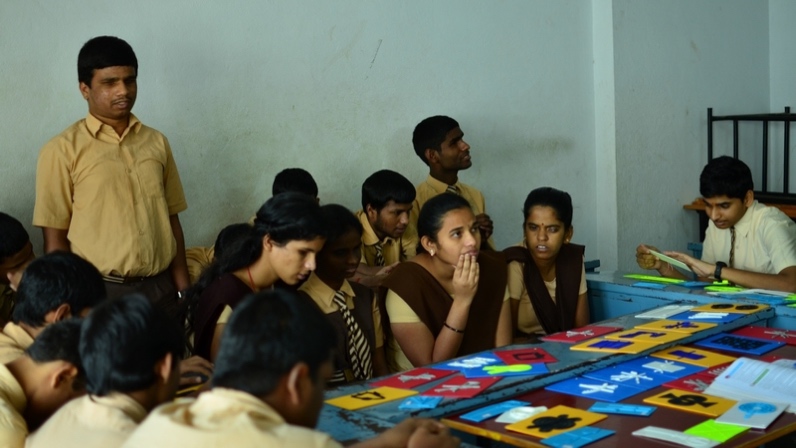 Children with visual impairment enjoy learning from their new 3D printed diagrams.
Having found a clear goal that can be easily fulfilled using 3D printing technology, think3D quickly got into action. They decided to digitize and create 3D models of all the diagrams used in the high school’s science textbook. The think3D team was confident that the teachers could explain the science concepts effectively using the 3D printed visual aids and they would be highly effective.
The entire team spent around 45 days designing and 3D printing out various diagrams from physics and chemistry. When the work was finished, the team took the models to the school to show the students. The project was a huge success: both teachers and students loved their new visual aids.
Charity report by http://think3d.in